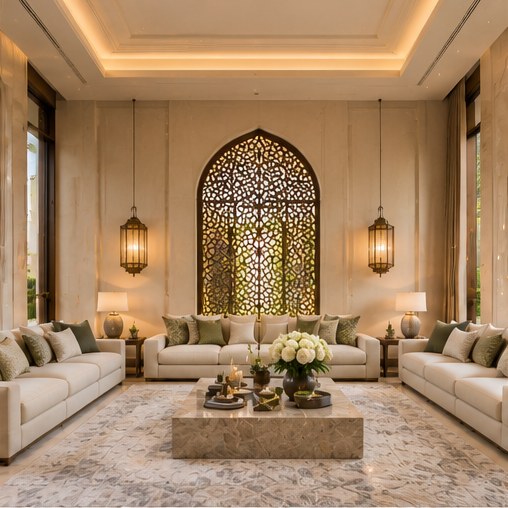
An impressive majlis is not simply a room with expensive seating. In Abu Dhabi, hospitality depends on how people converse, greet one another and move through a gathering. The room needs a comfortable everyday setting and a plan for occasions when guest numbers rise.
Plan a modern Abu Dhabi majlis around conversation, flexible gathering sizes, refreshments and acoustic comfort. The best result begins with actual family routines, a coordinated plan and decisions that can be maintained after handover.
01 — Begin with real gathering habits
Ask the household how many visitors typically come together and how long they stay. Test seating groups at realistic sizes, with tables close enough for tea and coffee but not blocking movement. An oversized empty central floor may look formal in a rendering while making conversation awkward. Mix fixed sofas with a few movable seats so the arrangement can shift without dragging heavy furniture across a polished floor.
02 — Keep service convenient and understated
A nearby pantry or discreet serving zone can reduce repeated journeys through private family spaces. Record where cups, trays, water, tissues and waste are stored; these details influence the usefulness of the room. If the family occasionally hosts a larger catered event, check door widths, the temporary staging position and whether staff can clear tables while guests remain seated. Hospitality deserves as much planning as feature walls.
03 — Improve sound and lighting quality
Stone, glass and high ceilings can make voices difficult to understand during overlapping conversations. Soft furnishings, rugs, drapery and selected acoustic treatments may control reverberation without compromising the material character. Create scenes for daytime visits, evening conversation and formal events, ensuring decorative fixtures do not shine into faces. Ask the lighting designer to coordinate dimming, control positions and maintenance access.
How this works in an Abu Dhabi villa
Consider a room used by eight guests most evenings and twenty during a festival. Draw both seating states rather than choosing furniture for only the maximum event. If the room becomes cramped, prioritise circulation and consider nearby overflow seating. A tested plan will often reveal that a more flexible furnishing system delivers a richer experience than filling every wall with matching sofas.
Design decisions to review
Use a focused decision review before approving expensive finishes, joinery and technical packages. Each point should be translated into an identifiable drawing, material sample or test that the project team can explain.
| Design focus | Owner question | Evidence to request |
|---|---|---|
| Begin with real gathering habits | Record typical and maximum guest numbers. | Ask the household how many visitors typically come together and how long they stay. |
| Keep service convenient and understated | Mock up seating at full furniture size. | A nearby pantry or discreet serving zone can reduce repeated journeys through private family spaces. |
| Improve sound and lighting quality | Check tea and coffee service routes. | Stone, glass and high ceilings can make voices difficult to understand during overlapping conversations. |
What to confirm before approval
Request a seated furniture plan for ordinary visits and a second plan for the largest realistic gathering. Ask the team to mark refreshment routes, movable chair storage, microphone or audio needs if relevant, and the location of lighting controls. Review ceiling and wall finishes for speech comfort rather than treating every hard surface as a purely visual choice. If acoustic performance is crucial, obtain advice from a specialist. A majlis works best when the host can welcome visitors without repeatedly rearranging the room.
Practical checklist
Use this list during the concept and design-development review. Record who is responsible for each action and when it will be checked.
- Record typical and maximum guest numbers.
- Mock up seating at full furniture size.
- Check tea and coffee service routes.
- Compare sound absorption against hard finishes.
- Set lighting scenes for several event types.
- Preserve access to the entrance and washrooms.
Frequently asked questions
Can a majlis be contemporary rather than traditional?
Yes. A contemporary majlis can express hospitality through scale, comfortable seating and local material references without imitating a historic room.
What is the biggest majlis layout mistake?
Choosing a perimeter arrangement without testing conversation distances and service routes often produces a room that is grand but uncomfortable.
Are rugs enough to solve echo?
Sometimes they help, but the result depends on the whole room. Tall or highly reflective rooms may need additional specialist acoustic input.
A memorable majlis supports gracious hospitality in both small conversations and full-house gatherings. Plan the social experience first and allow the finishes to reinforce it.